In high school when I was first learning about the American Revolution, I had no idea "journalists" had much to do with the lives of people as they do now - of course my history teacher never had the time to cover every topic in depth because she was preparing us for the AP exam and the Regents, and I had no time either to read any other parts of the textbook that weren't assigned to me. When she taught the class about the revolution and the people who influenced the revolution, I assumed these influential people must have really been bored because they purposefully wrote some of the simplest things in the most complicated language that I now have to decipher and make sure I remember for my exams. Now, some people may believe that I am ignorant and naive for what I've just revealed, but those were some of my thoughts in 11th grade. I digress. The reason I've chosen chapter one: Sewing the Seeds of Revolution over the other three chapters is because Streitmatter picked up where I left off learning about the revolution, and in much greater detail. His perspective is very different from my high school history teacher, and its truly fascinating the way he makes the American Revolution sound like something I would have loved to be a part of!
 |
| By Michael Barera (Own work) [CC-BY-SA-3.0 or GFDL], via Wikimedia Commons |
The art of journalism was very important to the American Revolution. It was journalist Samuel Adams who encouraged the colonists to fight for their independence from Britain. Adams was, as Streitmatter described him, someone who understood "the need to arouse public opinion as a step toward gaining grassroots support for the revolutionary ideas he and his associates espoused."(Streitmatter 7). Adams knew how to spark the colonists' fire - he knew that printing what British troops were doing in Boston would spread throughout all the colonies, and the injustice would make citizens livid enough to rebel and start a revolution. It was bad enough the colonists had to pay taxes to cover the debt their mother country put themselves in by fighting with the French over American land; but now the mother country had sent over troops 'to keep order', but they were doing more harm than good. Adams not only used the written word to let all colonists know what the soldiers were doing in Boston, he also used illustration. To make all colonist know exactly what happened in the Boston Massacre, Adams' newspaper "the Gazette accompanied the account with woodcuts of coffins representing the five men killed by the British soldiers."(Streitmatter 12).
 |
| By Scanned by uploader, originally by Thomas Paine. [Public domain], via Wikimedia Commons |
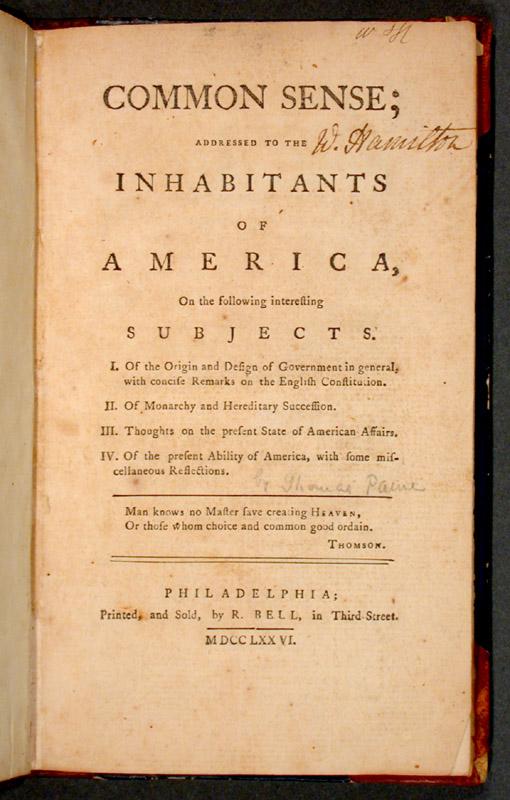
Thomas Paine's pamphlet 'Common Sense' unleashed a new kind of fire in the colonists. With Common Sense written, colonists were ready to fight for more than just lower taxes, but their full rights, and ultimately their independence. "Paine was the first writer in America to denounce the British monarch."(Streitmatter 14). Paine inspired the colonists to think about independence from Britain, which I think is a beautiful thing. Its kind of like a chain reaction. Thomas Paine worked as a tax collector in England, demanded better pay and got fired; he then was inspired by Benjamin Franklin to go to America, he goes and realizes what is going on in the colonies, and with a simple pamphlet stating the things that he believed the Americans deserved, and needed to know they deserved changed the history of America. How remarkable is that! I definitely did not learn most of this in history class.
Attributions
- Streitmatter, Rodger Mightier than the Sword: How the News Media Have Shaped American History


I like your blog, i think its short and sweet yet got your point across.
ReplyDeleteThank you so much!
DeleteI like how personal your blog was, it was very interesting to read and I felt as though we were having a conversation
ReplyDeleteThank you! I was going for that conversational tone ;)
DeleteYour blog is very personable and honest. I like the layout of your blog. Your layout wants me to read more
ReplyDeleteThanks Adam ..I like the layout too ..I'm really into shiny things
DeleteYour post was very personable which made it more interesting to read.
ReplyDeleteThanks lauren :)
DeleteWho knew you were so funny, and that you call yourself Dani? I feel like I've met you for the first time. You're so quiet in class, but you ROCK in your writing. Keep up the good work! Go Revolution.
ReplyDeleteThank you for the positive remark! There's a story behind me calling myself Dani ..but thats for another time :)
DeleteI like the blog and how you reveal your background in the history of the Revolution. Keep up the great writing. I'd love to see more of this and feel like a part of history again.
ReplyDeleteThanks Mary ..I'll try to keep my writing good.
Delete