Wednesday, May 2, 2012

McCarthyism

By Ted Wilkes at en.wikipedia (Transferred from en.wikipedia) [Public domain], from Wikimedia Commons

In my first blog, I ranted about how I seldom learned about the American Revolution in high school, on the count of we had to cover everything for the exams. Well, McCarthyism was yet another topic I seldom learned, and again Rodger Streitmatter managed to capture my attention on the topic at hand exactly where I left off. I just want to put this out there: my mind has not changed about Joseph McCarthy - I think the man is cuckoo for coco-puffs. (That's what I said in 11th grade history after we finished the chapter on McCarthyism)


By Ka34 at en.wikibooks [Public domain], from Wikimedia Commons

Chapter 10 of Mightier Than The Sword: Exposing Joe McCarthy: Television's Finest Hour is a compelling re-account of the rise and fall of Joseph McCarthy, and the role television had in depicting this incredibly conniving man. McCarthy's rise began during the Cold War, when America was trembling in their knickers at the thought of communist Soviet Union becoming the more dominant world power. And I understand why, after-all; The Soviets stood for equality among every citizen, there was no such thing as a bourgeoisie or a proletariat in a communist society, only a dictator who to the Americans were evil. McCarthy, the crafty fellow, played these fears of the American people to his greatest advantage.
By United Press (Library of Congress) [Public domain], via Wikimedia Commons


"Joe McCarthy began his campaign in February 1950 by waving a sheet of paper in front of a woman's club in Wheeling, West Virginia, and bellowing, "While I cannot take the time to name all of the men in the State Department who have been members of the Communist Party and a spy ring, I have here in my hand a list of 205 that were known to the Secretary of State and, nevertheless, are still working and shaping the policy in the State Department." Neither the audience not the nation that read the claim in the next day's newspapers knew that the letter contained not a single name."(Streitmatter 155).
 
By Anticommunist_Literature_1950s.[Public domain], via Wikimedia Commons

McCarthy was good at manipulating his listeners. He even manipulated the trust of the Fourth Estate. McCarthy accused government officials of being communist, and he went on a witch hunt against communism. Streitmatter says McCarthy used this tactic so that he could "propel the Republican Party into the White House."(153) His communist hunt definitely did work to place the Republicans in the White House. "He was cited as a major factor in helping the Republican Party take control of the White House in one of the most significant elections in American political history."(Streitmatter 157) McCarthy was on a roll; he was feared by many other Republicans, even by some of  his superiors, including, then "presidential candidate Dwight Eisenhower."(156) McCarthy was a bully, but a very smart one.


Joe McCarthy had a way of manipulating the press. McCarthy knew what it took to make news, and he had the whole thing figured out. "McCarthy was a master at manipulating the wire services - the Associated Press, United Press, and International News Service."(157) The wire services had great credibility, and because of that whatever they reported impacted other news outlets, including radio. The timing of McCarthy's accusations was one of his most successful when it came to manipulating the media. He always knew exactly when he was going to make an accusation - it was calculated so the wire services couldn't interview the accused person. His manipulative schemes allowed newspapers to publish a bunch of lies. This soon came to an end though with Edward R. Murrow and Fred W. Friendly. "In 1953, Murrow and Friendly decided the time had comes for a program to show that the paranoia ..had gone too far."(159) Murrow and Friendly aired the story of Milo Radulovich, a victim of McCarthy's accusations, to highlight just how far McCarthy had gone. Milo was a supposed communists because his father and sister subscribed to a Serbian-language paper. Their segment received positive reviews and with that, Murrow and Friendly went after the Man himself, Joe McCarthy. On TV, McCarthy was revealed as a liar, a contradict, a bully, someone who preyed on the innocent all for his own pleasure. Murrow had changed the view of many Americans on the issue of communism; they could breathe again with McCarthy exposed. This was the beginning of McCarthy's downward spiral from prominence in American society.


By U.S. Army Pictorial Center (The Challenge of Ideas, Part I (1961)) [Public domain], via Wikimedia Commons


Photograph courtesy of The Museum of Broadcast Communications
During the McCarthy hearings which were televised live, McCarthy's manipulation proved no match for the truth. Joseph Welch defeated McCarthy when it came to courtroom drama, because Welch possessed far more charm, and was more sensible with the Law. McCarthy was censored and lived the rest of his life an alcoholic.


You know when you know all the little details about an event, that it makes you feel really smart reading about it in another breadth, that's what Mightier than the Sword does for me. Its refreshed my mind on a lot of things I've learned in History class. Its really quite ironic that I'm learning more now on my own, than when I was being taught this stuff!

Wednesday, April 25, 2012

Using Journalism(Muckraking) As Reform


By American Industries [Public domain], via Wikimedia Commons
Investigative journalism today is definitely not what it was during the Progressive Era. During the Progressive Era, journalism exposed scandalous and corrupt people/corporations in an effort to better the lives of every American - be they blue collar or white collar. Today though, most of American journalism has gone to hollywood; focusing on the lives of celebrities and their drug abuses [some more than others]. And while this sells the news, and I do buy into because I love celebrity scandal as much as TMZ does, I still want to see scandals on corrupt people who are bringing this country into the shams - and I want to see it on the front page of a newspaper! I don't want to see a picture of Madonna's daughter smoking a cigarette. I want Muckraking  - digging for or through dirt, but it is practically gone from American journalism today. There are a few expose's here and there that highlight some form of corruption, but none that even comes close to the expose's of the Progressive Era, and though there are notable journalists who have greatly influenced the journalism community, their influences in my opinion are frail in comparison to some of the journalists who gladly accepted their title as 'Muckrakers'!

 
Henry Reuterdahl [Public domain], via Wikimedia Commons
In chapter six of Mightier than the Sword, Muckraking: The Golden Age of Reform Journalism, Streitmatter dives right into the historic background of the Progressive Era. From his description, America was doing extremely well for itself, economically speaking. Every aspect of American society that made money was the leading force in world economics. America wanted to an industrial country, and was made in part by laissez-faire, a policy which meant the government had no interference in the economy; the government was to stay out that sector. This was bad. America was turning "into a nation of the corporation, by the corporation, and for the corporation."(Streitmatter 85). The country was becoming more about the money, and less about the freedom and equality of people - the very thing the Founding Fathers fought for.

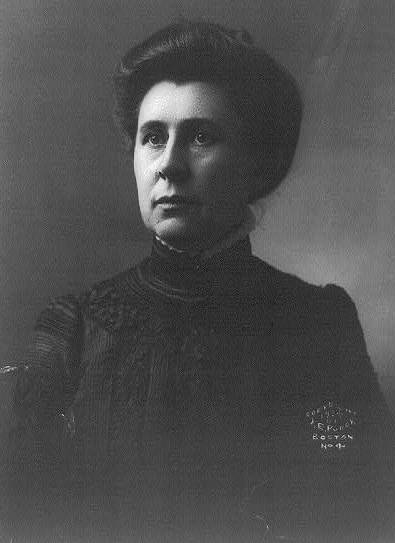
By J.E. Purdy; cropped by Beyond My Ken (talk) 10:12, 27 January 2010 (UTC) [Public domain], via Wikimedia Commons

During this switch of 'values', the rights of people were often neglected or outright denied. Workers of conglomerate corporations often had no rights - they worked long hours in miserably awful conditions, and their pay was just enough to get them by. The men behind these corporations were corrupt and money hungry - they were in short fit for a scandal. Journalists, or Muckrakers, a term "coined by President Theodore Roosevelt"(Streitmatter), began to expose things like these. One journalist in particular was good for the details, Ida Minerva Tarbell. She wrote about the monopolists with great detail, but she was known for her gripping narrative style, telling anecdotes of events as if she were there herself. "When she described the youthful Johnny Rockerfeller, she showed the financial cunning had always been his defining trait: "When he was eight years old, he raised a flock or turkeys. The flock was a fine one, for the owner had given its close care, and it was sold to advantage. A boy at eight usually earns to spend. This boy was different."(Streitmatter 89). Tarbell was known as the Queen of muckrakers, for not only did she write a good story, but she did her work, and was a great investigator. Her information was factual, and backed up by loads of evidence.
By Rockwood, New York, New York [Public domain], via Wikimedia Commons
Lincoln Steffens is noted as the first Muckraker. He investigated Municipal Corruption, and was always on the go doing it. He traveled from city to city to expose how "the quest for individual wealth and power infected governmental institutions, organized business, and the low-life criminal element to create a systematic world of graft much larger than its individual parts."(Streitmatter 88) In short Steffens examined municipal corruption and wrote about it in a way that called for reform, something much of the Muckrakers had in common - they all wanted reform, and their way of getting it was through investigative journalism.


By Uncredited Bain News Service photographer. [Public domain], via Wikimedia Commons
Another figure in the Muckraking reform was Ray Stannard Baker. He "earned a reputation as the world's greatest reporter because he totally immersed himself in whatever subject he was studying."(Streitmatter 92) Baker wrote gripping accounts around individuals who were impacted by whatever scandal or reform was going on. One in particular was focused on John Snyder and the miners strike. Snyder continued to work in the mines to feed his family while 17,000 others refused to until their salaries were raised. Snyder's house got burned to the ground while his wife left to visit her mother. When she came back, she tried searching for their furniture, but the neighbors had distributed it to each other. The way Baker reported his story gripped the hearts of his readers. It is what many of the Muckrakers were able to do. They dug deep and got their story, well enough to provoke change into this new era of America. This kind of journalism where you knew there was an uncovered scandal on the front of today's paper is missed.


Wednesday, April 18, 2012

Sewing the Seeds of Revolution

In high school when I was first learning about the American Revolution, I had no idea "journalists" had much to do with the lives of people as they do now - of course my history teacher never had the time to cover every topic in depth because she was preparing us for the AP exam and the Regents, and I had no time either to read any other parts of the textbook that weren't assigned to me. When she taught the class about the revolution and the people who influenced the revolution, I assumed these influential people must have really been bored because they purposefully wrote some of the simplest things in the most complicated language that I now have to decipher and make sure I remember for my exams. Now, some people may believe that I am ignorant and naive for what I've just revealed, but those were some of my thoughts in 11th grade. I digress. The reason I've chosen chapter one: Sewing the Seeds of Revolution over the other three chapters is because Streitmatter picked up where I left off learning about the revolution, and in much greater detail. His perspective is very different from my high school history teacher, and its truly fascinating the way he makes the American Revolution sound like something I would have loved to be a part of!

By Michael Barera (Own work) [CC-BY-SA-3.0 or GFDL], via Wikimedia Commons
The art of journalism was very important to the American Revolution. It was journalist Samuel Adams who encouraged the colonists to fight for their independence from Britain. Adams was, as Streitmatter described him, someone who understood "the need to arouse public opinion as a step toward gaining grassroots support for the revolutionary ideas he and his associates espoused."(Streitmatter 7). Adams knew how to spark the colonists' fire - he knew that printing what British troops were doing in Boston would spread throughout all the colonies, and the injustice would make citizens livid enough to rebel and start a revolution. It was bad enough the colonists had to pay taxes to cover the debt their mother country put themselves in by fighting with the French over American land; but now the mother country had sent over troops 'to keep order', but they were doing more harm than good. Adams not only used the written word to let all colonists know what the soldiers were doing in Boston, he also used illustration. To make all colonist know exactly what happened in the Boston Massacre, Adams' newspaper "the Gazette accompanied the account with woodcuts of coffins representing the five men killed by the British soldiers."(Streitmatter 12).

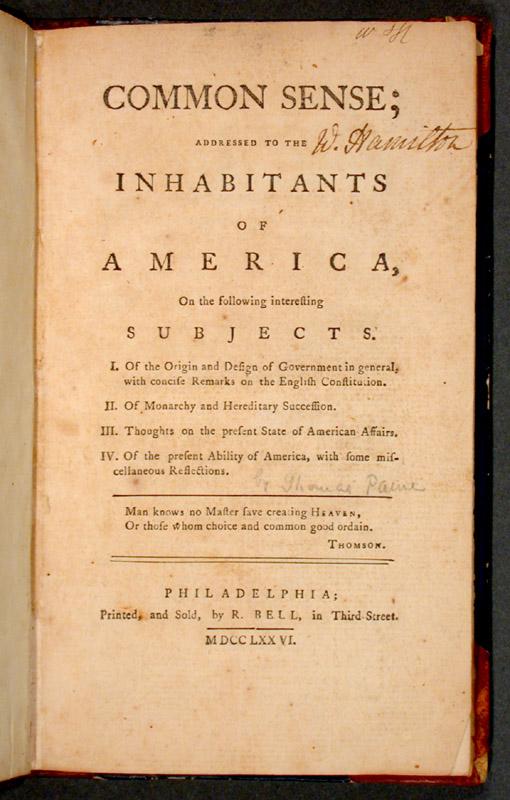
By Scanned by uploader, originally by Thomas Paine. [Public domain], via Wikimedia Commons
Thomas Paine's pamphlet 'Common Sense' unleashed a new kind of fire in the colonists. With Common Sense written, colonists were ready to fight for more than just lower taxes, but their full rights, and ultimately their independence. "Paine was the first writer in America to denounce the British monarch."(Streitmatter 14). Paine inspired the colonists to think about independence from Britain, which I think is a beautiful thing. Its kind of like a chain reaction. Thomas Paine worked as a tax collector in England, demanded better pay and got fired; he then was inspired by Benjamin Franklin to go to America, he goes and realizes what is going on in the colonies, and with a simple pamphlet stating the things that he believed the Americans deserved, and needed to know they deserved changed the history of America. How remarkable is that! I definitely did not learn most of this in history class.  


Attributions
  1. Streitmatter, Rodger Mightier than the Sword: How the News Media Have Shaped American History
   

Thursday, April 12, 2012

Revolution!

For my first post, I will focus on chapter one of Streitmatter's Mightier Than The Sword, which is Sowing the seeds of revolution.