 |
| By American Industries [Public domain], via Wikimedia Commons |
Investigative journalism today is definitely not what it was during the
Progressive Era. During the Progressive Era, journalism exposed
scandalous and corrupt people/corporations in an effort to better the
lives of every American - be they blue collar or white collar. Today
though, most of American journalism has gone to hollywood; focusing on
the lives of celebrities and their drug abuses [some more than others].
And while this sells the news, and I do buy into because I love
celebrity scandal as much as TMZ does, I still want to see scandals on
corrupt people who are bringing this country into the shams - and I want
to see it on the front page of a newspaper! I don't want to see a
picture of Madonna's daughter smoking a cigarette. I want Muckraking -
digging for or through dirt, but it is practically gone from American
journalism today. There are a few expose's here and there that highlight
some form of corruption, but none that even comes close to the expose's
of the Progressive Era, and though there are notable journalists who
have greatly influenced the journalism community, their influences in my
opinion are frail in comparison to some of the journalists who gladly
accepted their title as 'Muckrakers'!
 |
| Henry Reuterdahl [Public domain], via Wikimedia Commons |
In chapter six of Mightier than the Sword, Muckraking: The Golden Age of
Reform Journalism, Streitmatter dives right into the historic
background of the Progressive Era. From his description, America was
doing extremely well for itself, economically speaking. Every aspect of
American society that made money was the leading force in world
economics. America wanted to an industrial country, and was made in part
by laissez-faire, a policy which meant the government had no
interference in the economy; the government was to stay out that sector.
This was bad. America was turning "into a nation of the corporation, by
the corporation, and for the corporation."(Streitmatter 85). The
country was becoming more about the money, and less about the freedom
and equality of people - the very thing the Founding Fathers fought for.
 | |
| By J.E. Purdy; cropped by Beyond My Ken (talk) 10:12, 27 January 2010 (UTC) [Public domain], via Wikimedia Commons |
During this switch of 'values', the rights of people were often
neglected or outright denied. Workers of conglomerate corporations often
had no rights - they worked long hours in miserably awful conditions,
and their pay was just enough to get them by. The men behind these
corporations were corrupt and money hungry - they were in short fit for a
scandal. Journalists, or Muckrakers, a term "coined by President
Theodore Roosevelt"(Streitmatter), began to expose things like these.
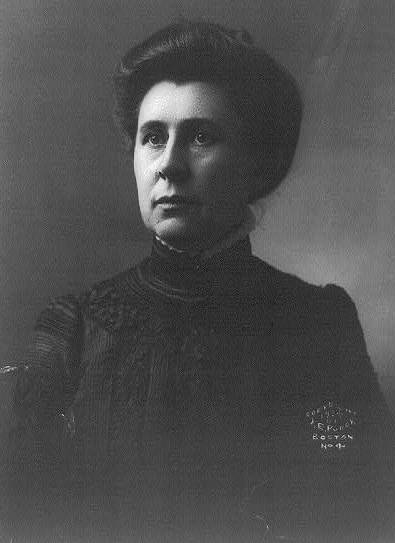
One journalist in particular was good for the details, Ida Minerva
Tarbell. She wrote about the monopolists with great detail, but she was
known for her gripping narrative style, telling anecdotes of events as
if she were there herself. "When she described the youthful Johnny
Rockerfeller, she showed the financial cunning had always been his
defining trait: "When he was eight years old, he raised a flock or
turkeys. The flock was a fine one, for the owner had given its close
care, and it was sold to advantage. A boy at eight usually earns to
spend. This boy was different."(Streitmatter 89). Tarbell was known as
the Queen of muckrakers, for not only did she write a good story, but
she did her work, and was a great investigator. Her information was
factual, and backed up by loads of evidence.
 |
| By Rockwood, New York, New York [Public domain], via Wikimedia Commons |
Lincoln Steffens is noted as the first Muckraker. He investigated
Municipal Corruption, and was always on the go doing it. He traveled
from city to city to expose how "the quest for individual wealth and
power infected governmental institutions, organized business, and the
low-life criminal element to create a systematic world of graft much
larger than its individual parts."(Streitmatter 88) In short Steffens
examined municipal corruption and wrote about it in a way that called
for reform, something much of the Muckrakers had in common - they all
wanted reform, and their way of getting it was through investigative
journalism.
 |
| By Uncredited Bain News Service photographer. [Public domain], via Wikimedia Commons |
Another figure in the Muckraking reform was Ray Stannard Baker. He
"earned a reputation as the world's greatest reporter because he totally
immersed himself in whatever subject he was studying."(Streitmatter 92)
Baker wrote gripping accounts around individuals who were impacted by
whatever scandal or reform was going on. One in particular was focused
on John Snyder and the miners strike. Snyder continued to work in the
mines to feed his family while 17,000 others refused to until their
salaries were raised. Snyder's house got burned to the ground while his
wife left to visit her mother. When she came back, she tried searching
for their furniture, but the neighbors had distributed it to each other.
The way Baker reported his story gripped the hearts of his readers. It
is what many of the Muckrakers were able to do. They dug deep and got
their story, well enough to provoke change into this new era of America. This kind of journalism where you knew there was an uncovered scandal on the front of today's paper is missed.


No comments:
Post a Comment